
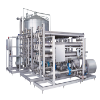

CM Series
Explain The Process Principle of Membrane Separation
Time:2018.03.21
Factors affecting membrane flux include temperature, pressure, solid content (TDS), ion concentration, viscosity, and so on. The basic process principle of membrane separation is relatively simple. In the filtration process, the feed liquid is pumped by the pump, and the feed liquid flows along the surface of the filter membrane at a certain flow rate. Substance molecules that are larger than the molecular weight cutoff of the membrane flow back to the feed tank without permeation through the membrane, and are smaller than the membrane molecular weight cutoff substance or molecule. Through the membrane, a dialysate is formed. Therefore, the membrane system has two outlets, one is the return liquid (concentrate) outlet and the other is the dialysate outlet. In the unit time (Hr) unit membrane area (m2) dialysate outflow amount (L) called the membrane flux (LMH), the filtration rate.
Because the membrane separation process is a purely physical process, with no phase change, energy saving, small size, and detachable characteristics, the membrane is widely used in fermentation, pharmaceutical, plant extraction, chemical, water treatment process and environmental protection industries. For organic matter of different composition, according to the molecular weight of organic matter, choose different membranes, choose the appropriate membrane technology, so as to achieve the best membrane flux and retention rate, and then increase production yield, reduce investment scale and operating costs.
To learn more about the separation of gas membranes, please pay attention to this site.
Telephone consultation: +86-010-64919358
Because the membrane separation process is a purely physical process, with no phase change, energy saving, small size, and detachable characteristics, the membrane is widely used in fermentation, pharmaceutical, plant extraction, chemical, water treatment process and environmental protection industries. For organic matter of different composition, according to the molecular weight of organic matter, choose different membranes, choose the appropriate membrane technology, so as to achieve the best membrane flux and retention rate, and then increase production yield, reduce investment scale and operating costs.
To learn more about the separation of gas membranes, please pay attention to this site.
Telephone consultation: +86-010-64919358